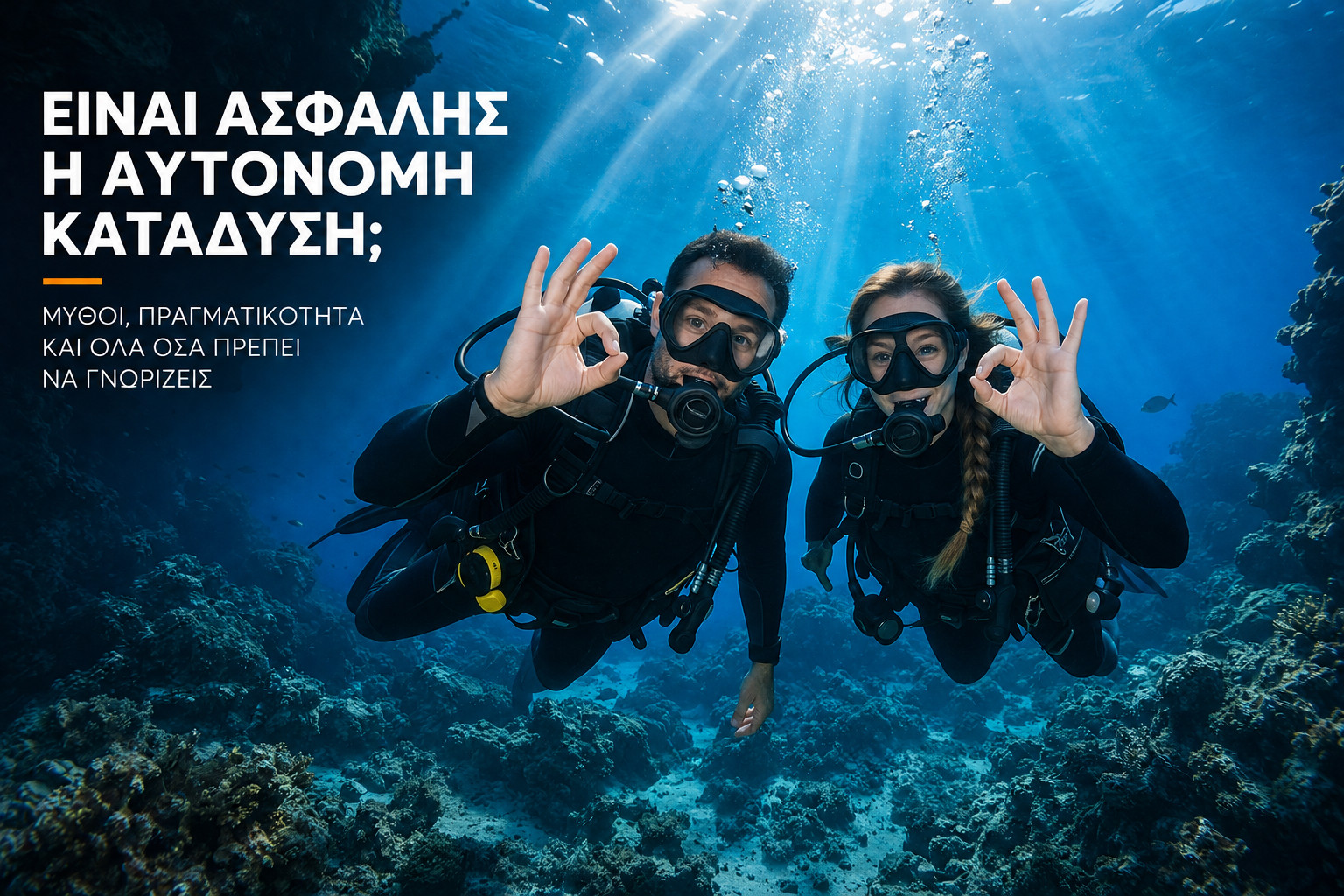
SCUBA diving is one of those experiences that many people feel curious about, but often hesitate to start.
One of the most common questions is simple: how long does it actually take to learn diving?
The answer is not complicated. It doesn’t take as long as most people imagine.
In reality, diving is structured in a way that allows you to start experiencing it very quickly, while at the same time giving you the option to evolve step by step.
Let’s take a look at what this journey looks like in practice.
The very first contact with diving happens through the Discover Scuba Diving experience.
This is not a long training process. It is a direct introduction to the underwater world.
After a short briefing and guidance from your instructor, you enter the water and experience breathing underwater for the first time.
This experience lasts about half a day (approximately 4 hours) and includes your first actual dive.
For most people, this is the moment everything changes. The moment they realize that diving is not something distant or difficult — it’s something they can actually do.
If someone decides to continue, the next step is the Open Water Diver course.
This is the first complete certification level and the point where someone becomes an independent diver, always with a buddy.
The course is completed in 3 to 5 days, meaning 3 to 5 sessions, with each session lasting approximately 5 hours.
During this time, the student learns the fundamental theory, practices skills in controlled conditions, and gradually transitions into the open sea.
It is a balanced process that combines learning with real experience, without unnecessary pressure.
After the first certification, many divers feel the need to explore more.
This is where the Advanced Open Water Diver course comes in.
It usually takes about 3 days to complete, with each session lasting around 5 hours, and includes 5 dives.
The goal here is not repetition, but expansion: deeper dives, navigation, and new types of diving experiences.
At this stage, diving becomes more personal and more exciting.
At some point, diving stops being just about your own experience.
This is where the Rescue Diver course comes in.
It requires 3 to 4 days to complete, including first aid training, with each session lasting about 5 hours.
Here, the focus shifts to awareness, responsibility, and understanding situations around you.
It’s not about difficulty — it’s about maturity as a diver.
After the core levels, diving becomes something you shape based on your own interests.
You can learn to use different breathing gases (PADI Enriched Air Diver – Nitrox),
dive deeper (PADI Deep Diver),
improve your finning technique (PADI Frog Kick Diver),
or explore shipwrecks (PADI Wreck Diver).
Each specialty adds a new dimension and allows you to build your own diving identity.
One of the biggest changes in modern diving education is that theory is now completed through e-learning.
This means that students spend their theoretical time at home, at their own pace.
As a result, when they arrive at the dive center, they focus almost entirely on practical training — which is what truly matters.
There is no need for rushed training.
The pace is always adjusted to the student, ensuring better understanding, confidence, and overall performance.
✔ Discover Scuba Diving: 3–4 hours (1 dive)
✔ Open Water Diver: 3–5 days (9 dives)
✔ Advanced Open Water Diver: ~3 days (5 dives)
✔ Rescue Diver: 3–4 days (dives depend on skill completion speed)
✔ Nitrox: ~4 hours (or +1 day with 2 dives)
✔ Deep Diver: 4 days (4 dives)
✔ Frog Kick Diver: 1 day (2 dives)
✔ Wreck Diver: 2 days (4 dives)
Learning to dive is not a long or exhausting process.
It is a journey that starts quickly and evolves naturally.
You don’t need months to begin.
You only need a few hours to take your first breath underwater — and from there, everything changes.
Because diving is not just something you learn.
It’s something you experience.
And once you experience it, time stops being the question.