One of the most common questions we hear at DIVENESS is:
“Am I too old to start scuba diving?”
The short answer is simple:
No.
There is no age that automatically prevents someone from learning to scuba dive. In reality, we have trained people from their teenage years all the way into their eighties.
What truly matters is not your age, but your overall health, your willingness to learn and your motivation to discover an entirely new world beneath the surface.
In fact, many people begin diving later in life, when they finally have more free time, greater financial flexibility and a stronger desire to enjoy meaningful experiences.
Modern recreational scuba diving is designed to be accessible.
Training is progressive, equipment is specifically developed to make diving comfortable and safe, and every diver learns step by step under the supervision of a professional instructor.
Before participating in any diving program, every student completes a standard medical questionnaire.
If necessary, a diving physician may be asked to provide medical clearance, ensuring that scuba diving is appropriate for that individual.
This approach allows people of many different ages to enjoy scuba diving safely.
Something interesting happens during scuba training.
While younger students often rely on physical ability, mature students frequently compensate with patience, discipline and the ability to carefully follow instructions.
They usually listen more attentively, rush less and remain calmer underwater.
These qualities often make learning easier and create excellent divers.
Experience, maturity and confidence are significant advantages in scuba diving.
One of the biggest misconceptions about scuba diving is that beginners immediately descend into deep water.
That simply isn’t true.
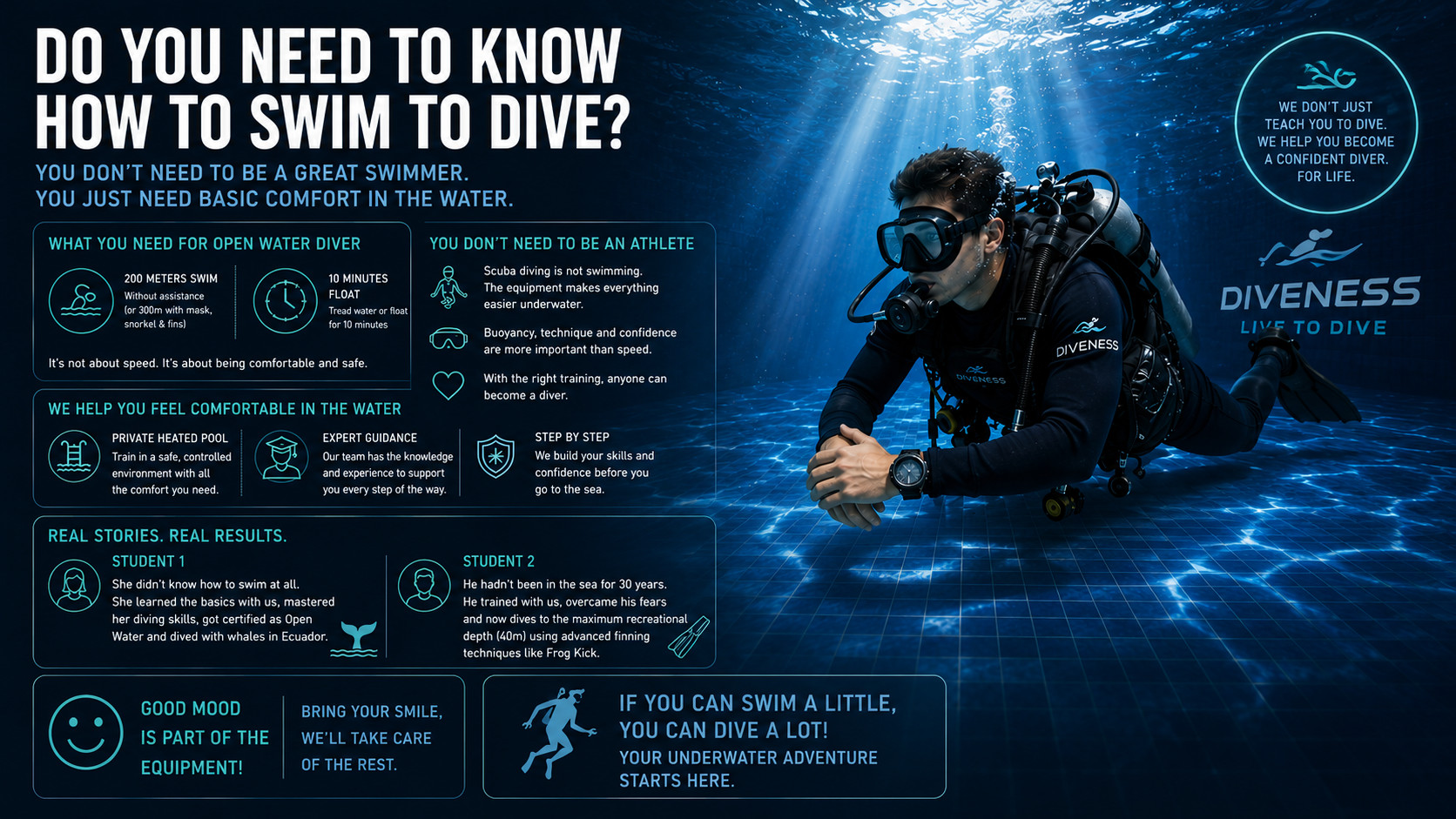
Every new diver starts in a controlled environment where basic skills are practiced repeatedly until they become comfortable.
At DIVENESS, this learning process becomes even more effective thanks to our private training pool.
The pool allows students to develop confidence in calm, controlled conditions before moving into open water.
Without waves, currents or external distractions, every new skill is learned more comfortably and naturally.
Students build confidence gradually, making their first sea dives far more enjoyable.
Throughout the years, we’ve met people who completely changed our perspective on age.
Jennifer was the oldest student I have ever trained.
She was 83 years old and had already been a certified diver, but she hadn’t dived for nearly fifteen years.
She joined us for a PADI Scuba Reactivate program.
From the very beginning, her kindness and warmth were unforgettable.
As our training progressed, something remarkable happened.
Jennifer admitted that during her original Open Water course, she had never managed to remove her mask underwater.
Using patience, encouragement and a calm learning approach, we gradually built her confidence.
Eventually, she completed the skill successfully.
At the end of the program, we hugged each other.
It was one of those moments that remind an instructor why teaching scuba diving is so rewarding.
Age had never been the obstacle.
Confidence was.
Another student who left a lasting impression was Mr. Stavros, a retired Greek gentleman living in Switzerland.
When I asked him what he was doing after retirement, he smiled and replied:
“I’m trying to spend my pension, my boy.”
I laughed and immediately told him,
“You are my role model.”
He completed both the Open Water Diver and Advanced Open Water Diver courses with remarkable determination.
Soon afterwards he began travelling around the world.
One of his favourite destinations was French Polynesia.
He kept sending me photographs of manta rays, sharks, dolphins and breathtaking coral reefs.
Eventually I joked with him:
“Please stop sending photos… I’m still teaching in Athens!”
Seeing him live the dream he had postponed for so many years was genuinely inspiring.
One of my earliest diving experiences happened shortly after earning my own certification.
I joined a boat in Corfu for a dive on a shallow shipwreck.
Among several young divers, I noticed two gentlemen who looked to be around seventy years old.
At first I assumed they were simply accompanying family members.
Then I watched them put on their scuba equipment.
They weren’t passengers.
They were divers.
The first thought that crossed my mind was:
“I want to be doing this when I’m their age.”
That single moment completely changed the way I imagined my own future.
Twenty years later, I still remember it.
One philosophy has always guided our training at DIVENESS.
We never rush people through a course.
Every student learns differently.
Some need more repetitions.
Others gain confidence immediately.
Our responsibility as instructors is to adapt the pace of the course to the student—not the other way around.
Learning should never feel like a race.
It should feel enjoyable, safe and rewarding.
Age alone is almost never the deciding factor.
Some medical conditions may require approval from a diving physician, but this is assessed individually.
That is why every student completes a medical questionnaire before training begins.
Once the appropriate medical requirements are met, people of many different ages can safely enjoy scuba diving.
One lesson we’ve learned after teaching hundreds of divers is this:
People rarely regret trying something new.
Much more often, they regret waiting too long.
Many students tell us exactly the same thing after their first dive:
“I wish I had done this years ago.”
Fortunately, scuba diving doesn’t care how old you are.
It only asks whether you’re ready to discover a completely different world.
If you’ve ever wondered whether you’re too old to start scuba diving, remember this:
The answer is almost always no.
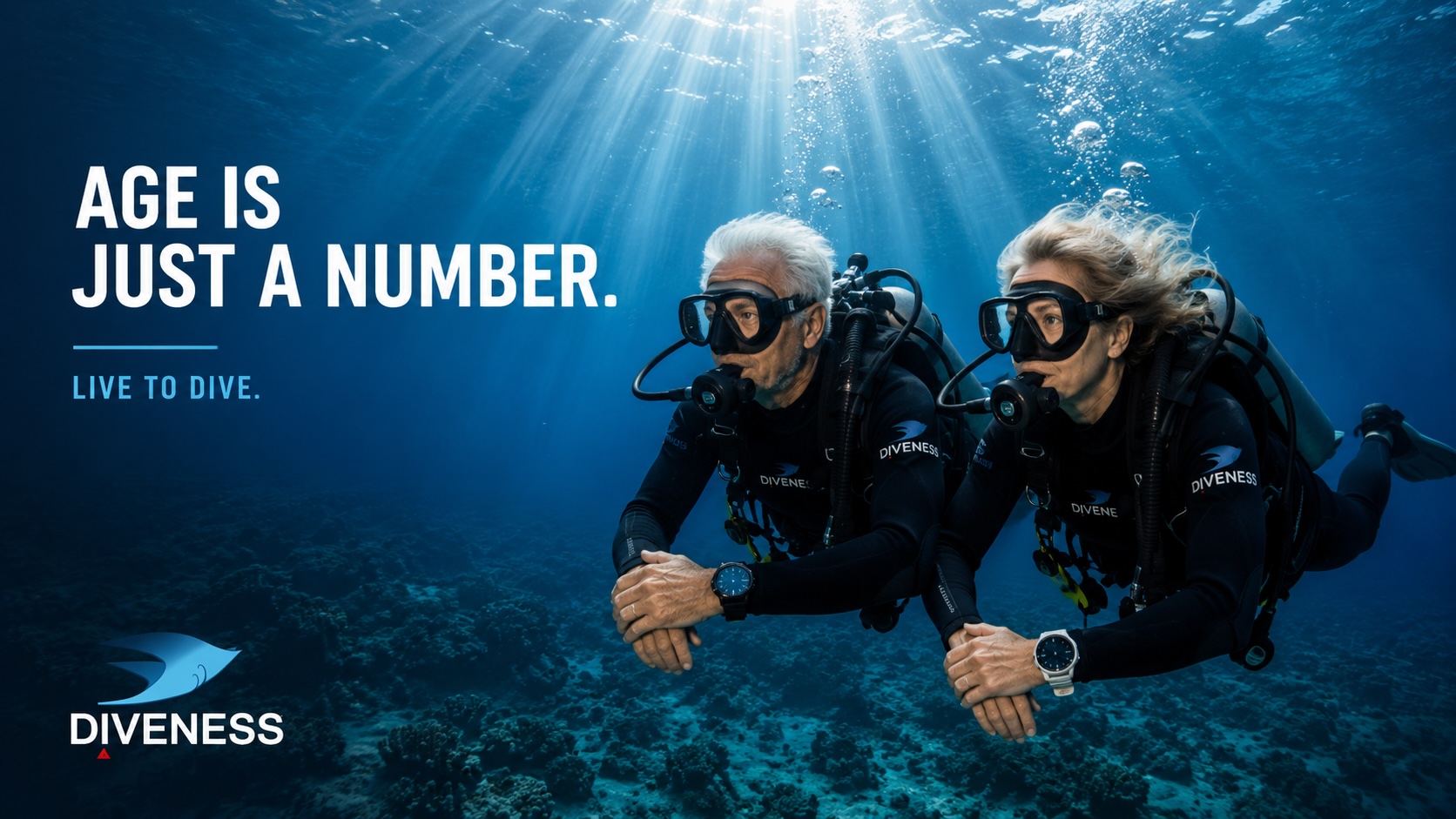
Age is only a number.
Curiosity, motivation and the willingness to learn are what truly matter.
Every diver begins exactly the same way—with a first breath underwater.
At DIVENESS, we’ve had the privilege of guiding students of every age, helping them build confidence step by step in a safe and supportive environment.
Whether you’re 25, 45, 65 or even older, your underwater adventure can begin today.
The only question left is:
When will you take your first breath underwater?