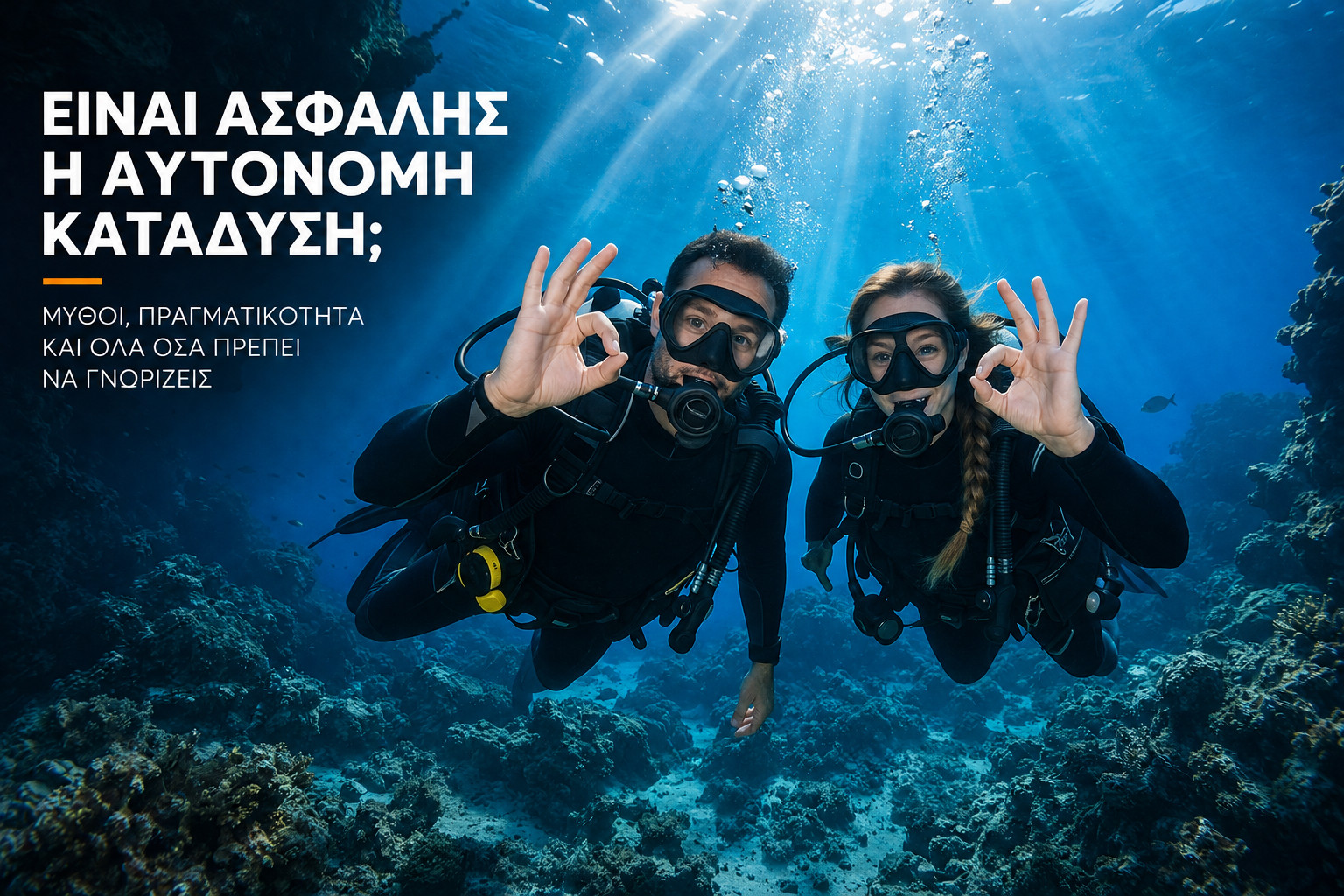
One of the most common questions people ask before trying diving is: “Is scuba diving dangerous?”
It is a completely natural concern. Breathing underwater and entering a totally different environment can easily create hesitation and uncertainty.
But what is the reality behind this perception?
Most fears related to scuba diving are not based on actual experience, but rather on impressions and misconceptions.
These are often influenced by:
✔ Movies and exaggerated scenes
✔ Stories lacking technical context
✔ Limited understanding of how diving works
In reality, modern scuba diving operates under strict international safety standards and clearly defined procedures.
The short answer is: no, when practiced correctly.
Scuba diving is considered a low-risk recreational activity when divers:
✔ Receive proper training (e.g. Open Water Diver)
✔ Dive within their certification limits
✔ Use appropriate and well-maintained equipment
✔ Follow established dive planning principles
Safety in diving is not a matter of luck — it is a matter of structure and education.
Like any activity, scuba diving involves potential risks. The difference is that these risks are well-known, predictable, and manageable.
Most incidents are associated with:
✔ Lack of proper training
✔ Ignoring established procedures
✔ Poor decision-making
✔ Improper equipment use
These are not random dangers, but preventable situations.
Scuba diving is a learned skill, not a spontaneous activity.
During a diver training program, students learn:
✔ How diving equipment functions
✔ How to manage buoyancy and air consumption
✔ How to prevent common problems
✔ How to respond calmly and effectively
Training is the single most important safety factor in diving.
Although many people perceive diving as extreme, statistically it is often safer than numerous everyday activities when performed responsibly.
What makes diving different is its system:
✔ Clearly defined limits
✔ Structured procedures
✔ Pre-dive safety checks
✔ Continuous education
Few recreational activities are as regulated and methodical.
Risk typically increases when fundamental diving principles are ignored.
Examples include:
✔ Diving beyond certification level
✔ Poor physical condition without evaluation
✔ Inadequate dive planning
✔ Overconfidence or lack of discipline
In other words, risk increases due to human decisions — not the activity itself.
Diving safety relies on simple but critical practices:
✔ Proper training and certification
✔ Suitable equipment and checks
✔ Conservative dive planning
✔ Effective communication
✔ Respecting personal limits
These principles form the foundation of safe diving worldwide.
Yes. Initial experiences take place through supervised introductory programs conducted by qualified instructors in controlled conditions.
Training is essential. Diving safety is directly linked to knowledge, skills, and procedural discipline.
No. Certified dive centers provide all necessary equipment, ensuring suitability and safety.
Yes. A medical questionnaire is completed before participation, helping identify any conditions requiring medical clearance.
No, when proper procedures are followed. Recreational scuba diving is designed to be safe, structured, and predictable.
SCUBA diving is not inherently dangerous when approached responsibly.
Safety is built upon training, equipment, planning, and adherence to procedures.
For anyone considering diving, the most important first step is choosing a professional and certified dive center that prioritizes safety and education.