If you ask an experienced diver which skill makes the biggest difference underwater, the answer is almost always the same:
Buoyancy!
Perfect buoyancy is not simply “good control.” It is the factor that determines how comfortably, safely, and efficiently you move in the underwater environment.
And it is what clearly separates a beginner from a truly capable diver.
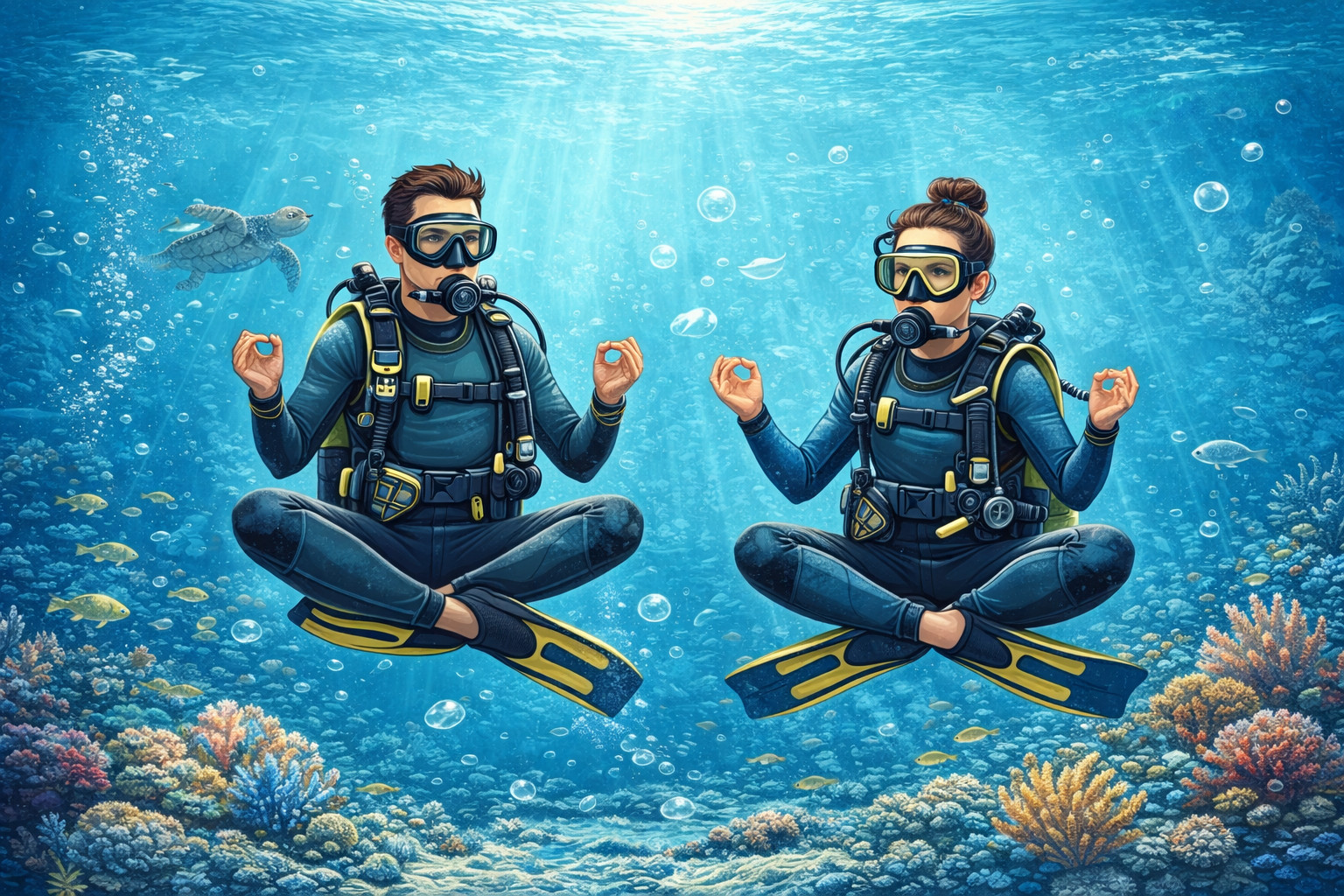
Buoyancy means a diver’s ability to maintain neutral balance in the water without rising or sinking uncontrollably.
With proper buoyancy a diver:
✔ Hovers steadily
✔ Moves with minimal effort
✔ Protects the environment
✔ Controls air consumption more effectively
✔ Dramatically increases comfort and safety
Proper buoyancy affects almost everything in diving.
A diver with good buoyancy does not “fight” the water. Movements are natural and stable.
Poor buoyancy means unnecessary movement, tension, and increased air consumption. In contrast, a neutral diver breathes more calmly and economically.
A stable position in the water reduces stress and fatigue, but it also provides something even more important:
Increased awareness of body position and depth.
Experienced divers do not rely exclusively on instruments. Over time, they develop an internal sense of their position in the water.
Even small depth changes are perceived through ear pressure.
Experienced divers often realize they are ascending or descending before checking their depth gauge, simply by sensing pressure changes.
This is an indication of high water familiarity and good buoyancy control.
With experience, the body functions as a “depth sensor.”
Water familiarity is the ability of a person to feel natural and comfortable in the aquatic environment.
It is not technique.
It is not equipment.
It is not certification.
It is adaptation.
Each dive increases water familiarity with a large “numerator.”
The body learns. The nervous system adapts. Perception becomes more precise.
The greater a diver’s water familiarity, the faster they reach the desired buoyancy control point.
Buoyancy stops being an exercise and becomes a natural condition.
👉 If you want to improve, dive often.
Completely normal.
Buoyancy is affected by:
✔ Breathing
✔ Weights & load distribution
✔ Exposure suit & equipment
✔ Body position (trim)
✔ Finning technique
✔ Environmental changes (density differences)
Density changes between different water conditions require readjustment and experience.
Breathing functions as a natural buoyancy regulator.
A scuba diver’s lungs and the BCD act as two air chambers that complement each other. Both add or remove volume through air, directly affecting body position in the water.
It is a bidirectional functional relationship.
When we feel negative and need to add air to the BCD, it is educationally correct to perform a controlled inhalation at the same time.
Likewise, when we are positive and release air from the BCD, it is ideal to perform a gentle exhalation.
What do we gain?
Faster response to what is required.
One air chamber complements the other. The BCD complements the lungs and the lungs complement the BCD.
The transition to neutral buoyancy becomes more immediate, precise, and stable.
Finning technique directly affects balance.
Incorrect movements create torque and instability. Proper technique means controlled propulsion and position maintenance.
Frog kick offers:
✔ Absolute control
✔ Body stability
✔ Minimal environmental disturbance
✔ Superior energy efficiency
The PADI Frog Kick Diver specialty focuses on:
✔ Frog kick technique
✔ Trim and stability
✔ Buoyancy control through movement
✔ Reduced air consumption
✔ Precision positioning in the water
It is designed for divers seeking meaningful skill development.
✔ Continuous BCD corrections
✔ Difficulty maintaining depth
✔ Instability & fatigue
✔ High air consumption
While swimming, look down and slightly back.
If you can see up to your quadriceps, you are in correct hydrodynamic trim.
If you see from the knees downward, your body is tilted with your head higher than your feet.
Initially, this check works as a visual correction cue. As water familiarity increases, the need to check decreases.
Insecurity turns into comfort.
Correction becomes internal.
At some point, the diver knows they are hydrodynamic — without needing to look.
✔ Training & guidance
✔ Breath control
✔ Proper weighting
✔ Trim improvement
✔ Correct finning technique
✔ Frequent diving to increase water familiarity
Buoyancy is the core of quality diving.
The more water familiarity increases, the more natural control becomes.
The more lungs and BCD synchronize, the faster the response.
The more often you dive, the faster you evolve.
Perfect buoyancy is not a destination.
It is evolution.
And it is built — dive by dive.